Tuesday, 3 May 2016

BLOGGER; Adsense and Google Plus Is Built Right In


Another nice feature about Blogger is that you can start monetizing your blog from day one — assuming that you have an Adsense account, that is. Even if you don’t have one, setting things up through Blogger is simple, and freeBlogger and Adsense
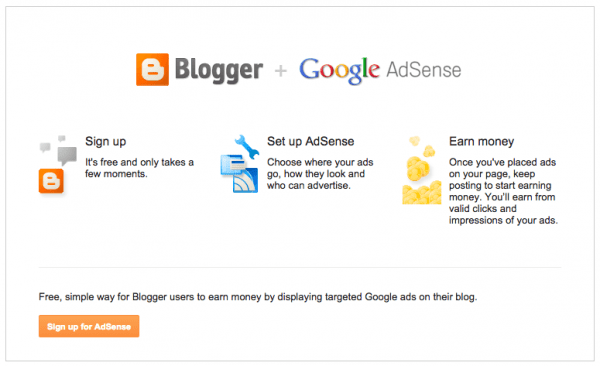

Additionally, connecting your Google account to your blog is something that is pretty much taken care of. Since Blogger is owned by Google, they’ve made sure that these connections are simple.Unlike WordPress which uses Widgets to display certain apps in designated areas, Blogger uses what they call, Gadgets, that display buttons or apps in widget-like areas
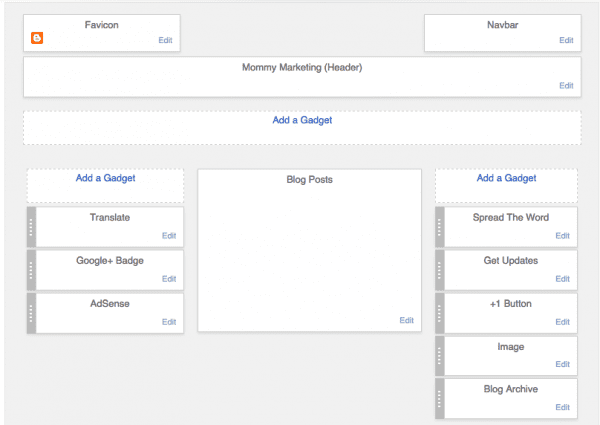
Gadget Areas highlighted in blue

The only major difference is that you can only use the Gadgets that are given in Blogger, however, they do have the basic Google oriented Gadgets for your Gadget Areas:1.Google Plus Button2.Google Plus Badge3.Adsense Boxes for monetizingAnother plus is that you can you can even add Google Analytics on your Blogger site to really track the traffic and conversion on your site. There are a few more Gadgets that you can choose from, but in all honesty, it’s all very limited.

The Bad

You’re Going To Look Like Every Other Blogger Site
When it comes to templates, the options given by Blogger are both slim, and frankly, just plain hideous. (*cringe*) You have only seven templates to choose from, and even though each one has only few different design options, they’re all a bit clunky looking and not that pleasing to look at.
Now don’t get me wrong — the drag and drop options for the Blogger Layout, and the ability to easily change the width of the blog using slider options is very nice. Outside of that, though, making customizations to your blog in order to make it stand above the rest is going to be near impossible if you don’t know HTML and CSS.
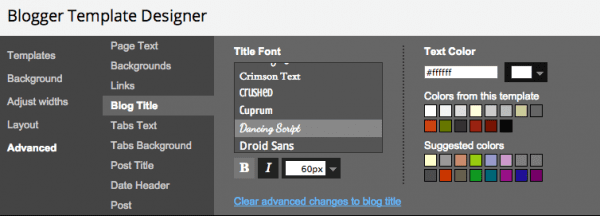
Screen Shot 2014-10-09 at 12.12.28 PM


The Advanced Options in the Blogger Template Designer (pictured above) area allow you to make changes to the template that you chose. Although this area does give you some nice mouse-click control — perfect for someone who has no web design knowledge —  you’ll still be stuck with a template layout that always looks the same as everyone else.

There are sites out there that offer free Blogger Templates to help give you a blog that looks a bit more unique, but it can be tricky to upload them. And if your blog has some content on it already, there is a chance that a new template from one of those sites will wipe everything clean. (Ouch!)

Limitations Galore

Blogger has a lot to offer: it’s free, it’s easy to use, and you can start a blog in under five minutes — two thumbs up on that front. But, that still doesn’t change the fact that it is hampered by a ton of limitations that make it just plain unsuitable for a business driven website.No Comment Moderation. Comments can be a huge part of blog’s success, or its failure. With Blogger, there is no area in your dashboard to control your comments. The only options you do have are to either allow the comments on you blog, or not. And if you want to reply to comments, you’ll have to go to each individual page or post to do so. If your site gains some traction or popularity, this task will quickly become time consuming.Only 1GB Worth Of Picture Storage. Yes, you read that right: 1 stinkin’ gigabyte worth of photos. Yikes! The Blogger Help page does state that “if you’ve upgraded to Google+, your photos will be stored in Google+ Photos, where you have 15GB of storage space shared with Gmail and Drive”, but that’s still not very much.The only good thing about using Google Drive is that only photos that are larger than 2048 x 2048 count towards that limit; therefore, if you stick to using photos that are under that size, then you can technically have as many pictures as you like without any worries. Unless of course, Google decides to change their rules down the road — which they always do — and then you’ll be in a bit of a predicament.Page Size Limit Set At 1MB. Just one more major limitation to deal with. Do you know how many megabytes are in a gigabyte? Only a thousand, and you only get 1 measly little megabyte for each of your pages. A single decent sized picture could easily eat up a quarter of that megabyte…The other thing that Blogger mentions, is that even though “individual posts do not have a specific size limit… very large posts may run you up against the page size limit.” So, essentially, what they’re getting at is that your posts shouldn’t be more than 1MB either. This limitation is a huge drawback and one that really shouldn’t be ignored.

Blogger; Legal and social consequences


Blogging can result in a range of legal liabilities and other unforeseen consequences.

Image result for image of blogger

Defamation or liability

Several cases have been brought before the national courts against bloggers concerning issues of defamation or liability. U.S. payouts related to blogging totaled $17.4 million by 2009; in some cases these have been covered by umbrella insurance. The courts have returned with mixed verdicts. Internet Service Providers (ISPs), in general, are immune from liability for information that originates with third parties (U.S. Communications Decency Act and the EU Directive 2000/31/EC).

In Doe v. Cahill, the Delaware Supreme Court held that stringent standards had to be met to unmask the anonymous bloggers, and also took the unusual step of dismissing the libel case itself (as unfounded under American libel law) rather than referring it back to the trial court for reconsideration.  In a bizarre twist, the Cahills were able to obtain the identity of John Doe, who turned out to be the person they suspected: the town's mayor, Councilman Cahill's political rival. The Cahills amended their original complaint, and the mayor settled the case rather than going to trial.
In January 2007, two prominent Malaysian political bloggers, Jeff Ooi and Ahirudin Attan, were sued by a pro-government newspaper, The New Straits Times Press (Malaysia) Berhad, Kalimullah bin Masheerul Hassan, Hishamuddin bin Aun and Brenden John a/l John Pereira over an alleged defamation. The plaintiff was supported by the Malaysian government. Following the suit, the Malaysian government proposed to "register" all bloggers in Malaysia in order to better control parties against their interest.  This is the first such legal case against bloggers in the country.
In the United States, blogger Aaron Wall was sued by Traffic Power for defamation and publication of trade secrets in 2005. According to Wired magazine, Traffic Power had been "banned from Google for allegedly rigging search engine results." Wall and other "white hat" search engine optimization consultants had exposed Traffic Power in what they claim was an effort to protect the public. The case addressed the murky legal question of who is liable for comments posted on blogs. The case was dismissed for lack of personal jurisdiction, and Traffic Power failed to appeal within the allowed time.
In 2009, a controversial and landmark decision by The Hon. Mr Justice Eady refused to grant an order to protect the anonymity of Richard Horton. Horton was a police officer in the United Kingdom who blogged about his job under the name "NightJack".
In 2009, NDTV issued a legal notice to Indian blogger Kunte for a blog post criticizing their coverage of the Mumbai attacks. The blogger unconditionally withdrew his post, which resulted in several Indian bloggers criticizing NDTV for trying to silence critics.

Employeer

Image result for image of blogger


Employees who blog about elements of their place of employment can begin to affect the brand recognition of their employer. general, attempts by emplDelta Air Lines fired flight attendant Ellen Simonetti because she posted photographs of herself in uniform on an airplane and because of comments posted on her blog "Queen of Sky: Diary of a Flight Attendant" which the employer deemed inappropriate. This case oyee bloggers to protect themselves by maintaining anonymity have proved ineffective.highlighted the issue of personal blogging and freedom of expression versus employer rights and responsibilities, and so it received wide media attention. Simonetti took legal action against the airline for "wrongful termination, defamation of character and lost future wages". The suit was postponed while Delta was in bankruptcy proceedings.In early 2006, Erik Ringmar, a senior lecturer at the London School of Economics, was ordered by the convenor of his department to "take down and destroy" his blog in which he discussed the quality of education at the school.Mark Cuban, owner of the Dallas Mavericks, waMark Jen was terminated in 2005 after 10 days of employment as an Assistant Product Manager at Google for discussing corporate sec


In India, blogger Gaurav Sabnis resigned from IBM after his posts questioned the claims of a management school IIPM.

Jessica Cutler, aka "The Washingtonienne", blogged about her sex life while employed as a congressional assistant. After the blog was discovered and she was fired, she wrote a novel based on her experiences and blog: The Washingtonienne: A Novel. Cutler is presently being sued by one of her former lovers in a case that could establish the extent to which bloggers are obligated to protect the privacy of their real life associates.
Catherine Sanderson, a.k.a. Petite Anglaise, lost her job in Paris at a British accountancy firm because of blogging. Although given in the blog in a fairly anonymous manner, some of the descriptions of the firm and some of its people were less than flattering. Sanderson later won a compensation claim case against the British firm, however.
On the other hand, Penelope Trunk wrote an upbeat article in the Boston Globe in 2006, entitled "Blogs 'essential' to a good career".She was one of the first journalists to point out that a large portion of bloggers are professionals and that a well-written blog can help attract employers.

Political dangers


Image result for image of blogger
Blogging can sometimes have unforeseen consequences in politically sensitive areas. Blogs are much harder to control than broadcast or even print media. As a result, totalitarian and authoritarian regimes often seek to suppress blogs and/or to punish those who maintain them.
In Singapore, two ethnic Chinese were imprisoned under the country’s anti-sedition law for posting anti-Muslim remarks in their blogs.
Egyptian blogger Kareem Amer was charged with insulting the Egyptian president Hosni Mubarak and an Islamic institution through his blog. It is the first time in the history of Egypt that a blogger was prosecuted. After a brief trial session that took place in Alexandria, the blogger was found guilty and sentenced to prison terms of three years for insulting Islam and inciting sedition, and one year for insulting Mubarak.
Egyptian blogger Abdel Monem Mahmoud was arrested in April 2007 for anti-government writings in his blog. Monem is a member of the then banned Muslim Brotherhood.
After the 2011 Egyptian revolution, the Egyptian blogger Maikel Nabil Sanad was charged with insulting the military for an article he wrote on his personal blog and sentenced to 3 years.
After expressing opinions in his personal blog about the state of the Sudanese armed forces, Jan Pronk, United Nations Special Representative for the Sudan, was given three days notice to leave Sudan. The Sudanese army had demanded his deportation.
In Myanmar, Nay Phone Latt, a blogger, was sentenced to 20 years in jail for posting a cartoon critical of head of state Than Shwe.


Personal safety


One consequence of blogging is the possibility of attacks or threats against the blogger, sometimes without apparent reason. Kathy Sierra, author of the blog "Creating Passionate Users", was the target of threats and misogynistic insults to the point that she canceled her keynote speech at a technology conference in San Diego, fearing for her safety. While a blogger's anonymity is often tenuous, Internet trolls who would attack a blogger with threats or insults can be emboldened by anonymity. Sierra and supporters initiated an online discussion aimed at countering abusive online behavior and developed a blogger's code of conduct.


BehaviorImage result for image of blogger

The Blogger's Code of Conduct is a proposal by Tim O'Reilly for bloggers to enforce civility on their blogs by being civil themselves and moderating comments on their blog. The code was proposed in 2007 due to threats made to blogger Kathy Sierra.The idea of the code was first reported by BBC News, who quoted O'Reilly saying, "I do think we need some code of conduct around what is acceptable behaviour, I would hope that it doesn't come through any kind of regulation it would come through self-regulation.

O'Reilly and others came up with a list of seven proposed ideas:Take responsibility not just for your own words, but for the comments you allow on your blog.Label your tolerance level for abusive comments.Consider eliminating anonymous comments.Ignore the trolls.Take the conversation offline, and talk directly, or find an intermediary who can do so.If you know someone who is behaving badly, tell them so.Don't say anything online that you wouldn't say in person.These ideas were predictably intensely discussed on the Web and in the media. While the internet has continued to grow, with online activity and discourse only picking up both in positive and negative ways in terms of blog interaction, the proposed Code has drawn more widespread attention to the necessity of monitoring blogging activity and social norms being as important online as offline


Blogger; Types of Blog

Types

There are many different types of blogs, differing not only in the type of content, but also in the way that content is delivered or written.

Image result for image of blogger

Personal blogs


The personal blog is an ongoing diary or commentary written by an individual.
Collaborative blogs or group blogs
A type of weblog in which posts are written and published by more than one author. The majority of high-profile collaborative blogs are based around a single uniting theme, such as politics or technology. In recent years, the blogosphere has seen the emergence and growing popularity of more collaborative efforts, often set up by already established bloggers wishing to pool time and resources, both to reduce the pressure of maintaining a popular website and to attract a larger readership.

Microblogging

Microblogging is the practice of posting small pieces of digital content—which could be text, pictures, links, short videos, or other media—on the Internet. Microblogging offers a portable communication mode that feels organic and spontaneous to many and has captured the public imagination. Friends use it to keep in touch, business associates use it to coordinate meetings or share useful resources, and celebrities and politicians (or their publicists) microblog about concert dates, lectures, book releases, or tour schedules. A wide and growing range of add-on tools enables sophisticated updates and interaction with other applications. The resulting profusion of functionality is helping to define new possibilities for this type of communication.Examples of these include Twitter, Facebook, Tumblr and, by far the largest, WeiBo.

Cosrporate and organizational blog

A blog can be private, as in most cases, or it can be for business purposes. Blogs used internally to enhance the communication and culture in a corporation or externally for marketing, branding or public relations purposes are called corporate blogs. Similar blogs for clubs and societies are called club blogs, group blogs, or by similar names; typical use is to inform members and other interested parties of club and member activities.

Aggregated blogs

Individuals or organization may aggregate selected feeds on specific topic or product and provide combined view for its readers. This allow readers to concentrate on reading instead of searching for quality on-topic content and managing subscription. Many such aggregation called planets from name of Planet (software) that perform such aggregation, hosting sites usually have planet. subdomain in domain name (like http://planet.gnome.org/).

By genre

Some blogs focus on a particular subject, such as political blogs, journalism blogs, health blogs, travel blogs (also known as travelogs), gardening blogs, house blogs, book blogs, fashion blogs, beauty blogs, lifestyle blogs, wedding blogs, project blogs, psychology blogs, sociology blogs, education blogs, niche blogs, classical music blogs, quizzing blogs, legal blogs (often referred to as a blawgs), or dreamlogs. How To/Tutorial blogs are becoming increasing popular. Two common types of genre blogs are art blogs and music blogs. A blog featuring discussions especially about home and family is not uncommonly called a mom blog and one made popular is by Erica Diamond who created Womenonthefence.com which is syndicated to over two million readers monthly. While not a legitimate type of blog, one used for the sole purpose of spamming is known as a Splog.

By media type

A blog comprising videos is called a vlog, one comprising links is called a linklog, a site containing a portfolio of sketches is called a sketchblog or one comprising photos is called a photoblog. Blogs with shorter posts and mixed media types are called tumblelogs. Blogs that are written on typewriters and then scanned are called typecast or typecast blogs.A rare type of blog hosted on the Gopher Protocol is known as a phlog.

By device

A blog can also be defined by which type of device is used to compose it. A blog written by a mobile device like a mobile phone or PDA could be called a moblog. One early blog was Wearable Wireless Webcam, an online shared diary of a person's personal life combining text, video, and pictures transmitted live from a wearable computer and EyeTap device to a web site. This practice of semi-automated blogging with live video together with text was referred to as sousveillance. Such journals have been used as evidence in legal matters.[citation needed]

Reverse blog

A reverse blog is composed by its users rather than a single blogger. This system has the characteristics of a blog, and the writing of several authors. These can be written by several contributing authors on a topic, or opened up for anyone to write. There is typically some limit to the number of entries to keep it from operating like a web forum.


Blogger ; About Blog

Blogger" redirects here. For the Google service with same name, see Blogger (service). For other uses, see Blog (disambiguation).

JournalismSimons Perskaart DOM.jpgNews Writing style Ethics Objectivity News values Attribution Defamation Editorial independence Journalism school Index of journalism articlesAreasArts Business Data Entertainment Environment Fashion Medicine Politics Science Sports Technology Trade Traffic Weather WorldGenresAdvocacy Analytic Blogging Broadcast Citizen Civic Collaborative Comics-based Community Database Gonzo Immersion Investigative Literary Muckraking Narrative "New Journalism" Non-profit Online Opinion Peace Photojournalism Scientific Sensor Underground Visual WatchdogSocial impactFourth Estate Fifth Estate Freedom of the press Infotainment Media bias Public relations Press service Propaganda model Yellow journalismNews mediaNewspapers Magazines TV and radio Internet News agencies Alternative media

Image result for image of blogger


RolesJournalists (reporters) Columnist Blogger Editor Copy editor Meteorologist Presenter (news) Photographer Pundit / commentatorJournalism PortalCategory: Journalismv t eA blog (a truncation of the expression weblog)[1] is a discussion or informational site published on the World Wide Web consisting of discrete entries ("posts") typically displayed in reverse chronological order (the most recent post appears first). Until 2009, blogs were usually the work of a single individual[citation needed], occasionally of a small group, and often covered a single subject. More recently, "multi-author blogs" (MABs) have developed, with posts written by large numbers of authors and professionally edited. MABs from newspapers, other media outlets, universities, think tanks, advocacy groups, and similar institutions account for an increasing quantity of blog traffic. The rise of Twitter and other "microblogging" systems helps integrate MABs and single-author blogs into societal newstreams. Blog can also be used as a verb, meaning to maintain or add content to a blog.
The emergence and growth of blogs in the late 1990s coincided with the advent of web publishing tools that facilitated the posting of content by non-technical users. (Previously, a knowledge of such technologies as HTML and FTP had been required to publish content on the Web.)
A majority are interactive, allowing visitors to leave comments and even message each other via GUI widgets on the blogs, and it is this interactivity that distinguishes them from other static websites.In that sense, blogging can be seen as a form of social networking service. Indeed, bloggers do not only produce content to post on their blogs, but also build social relations with their readers and other bloggers. However, there are high-readership blogs which do not allow comments.
Many blogs provide commentary on a particular subject; others function as more personal online diaries; others function more as online brand advertising of a particular individual or company. A typical blog combines text, images, and links to other blogs, Web pages, and other media related to its topic. The ability of readers to leave comments in an interactive format is an important contribution to the popularity of many blogs. Most blogs are primarily textual, although some focus on art (art blogs), photographs (photoblogs), videos (video blogs or "vlogs"), music (MP3 blogs), and audio (podcasts). Microblogging is another type of blogging, featuring very short posts. In education, blogs can be used as instructional resources. These blogs are referred to as edublogs.
On 16 February 2011, there were over 156 million public blogs in existence. On 20 February 2014, there were around 172 million Tumblr[4] and 75.8 million WordPress blogs in existence worldwide. According to critics and other bloggers, Blogger is the most popular blogging service used today. However, Blogger does not offer public statistics. Technorati has 1.3 million blogs as of February 22, 2014.


Bringing HTTPS to all blogspot domain blogS

HTTPS is fundamental to internet security; 

It protects the integrity and confidentiality of data sent between websites and visitors' browsers. Last September, we began rolling out HTTPS support for blogspot domain blogs so you could try it out. Today, we’re launching another milestone: an HTTPS version for every blogspot domain blog. With this change, visitors can access any blogspot domain blog over an encrypted channel.


Be redirected to the HTTPS version of your blog at https://<your-blog>.blogspot.com even if they go to http://<your-blog>.blogspot.com. 

If you choose to turn off this setting, visitors will have two options for viewing your blog: the unencrypted version at http://<your-blog>.blogspot.com or the encrypted version at https://<your-blog>.blogspot.com.
The new HTTPS Redirect setting in the Blogger dashboard
Please be aware that mixed content may cause some of your blog's functionality not to work in the HTTPS version. Mixed content is often caused by incompatible templates, gadgets, or post content. While we're proactively fixing most of these errors, some of them can only be fixed by you, the blog authors. To help spot and fix these errors, we recently released a mixed content warning tool that alerts you to possible mixed content issues in your posts, and gives you the option to fix them automatically before saving.
Existing links and bookmarks to your blogs are not affected by this launch, and will continue to work. Please note that blogs on custom domains will not yet have HTTPS support.
This update expands Google's HTTPS Everywhere mission to all blogspot domain blogs. We appreciate your feedback and will use it to make future impro
The HTTPS indicator in the Chrome browser
As part of this launch, we're removing the HTTPS Availability setting. Even if you did not previously turn on this setting, your blogs will have an HTTPS version enabled.
We’re also adding a new setting called HTTPS Redirect that allows you to opt-in to redirect HTTP requests to HTTPS. While all blogspot blogs will have an HTTPS version enabled, if you turn on this new setting, all visitors will vements.


Blogger (service)

Blogger is a blog-publishing service that allows multi-user blogs with time-stamped entries. It was developed by Pyra Labs, which was bought by Google in 2003. Generally, the blogs are hosted by Google at a subdomain of blogspot.com. Blogs can also be hosted in the registered custom domain of the blogger (like www.example.com). So blogspot.com domain publishings will be redirected to the custom domain.A user can have up to 100 blogs per account.
Up until May 1, 2010, Blogger allowed users to publish blogs on other hosts, via FTP. All such blogs had (or still have) to be moved to Google's own servers, with domains other than blogspot.com allowed via custom URLs.[6] Unlike WordPress.com, Blogger allows its users to use their own domain free of charge, while WordPress.com charges around $13 to use a custom domain. Blogger cannot be installed on a web server. One has to use DNS facilities to redirect a custom URL to a blogspot domain.
Blogger Vs WordPress Why I Switched

Available designs


On August 23, 1999, Blogger was launched by Pyra Labs. As one of the earliest dedicated blog-publishing tools, it is credited for helping popularize the format. In February 2003, Pyra Labs was acquired by Google under undisclosed terms. The acquisition allowed premium features (for which Pyra had charged) to become free. In October 2004, Pyra Labs' co-founder, Evan Williams, left Google. In 2004, Google purchased Picasa; it integrated Picasa and its photo sharing utility Hello into Blogger, allowing users to post photos to their blogs.
On May 9, 2004, Blogger introduced a major redesign, adding features such as web standards-compliant templates, individual archive pages for posts, comments, and posting by email. On August 14, 2006, Blogger launched its latest version in beta, codenamed "Invader", alongside the gold release. This migrated users to Google servers and had some new features, including interface language in French, Italian, German and Spanish. In December 2006, this new version of Blogger was taken out of beta. By May 2007, Blogger had completely moved over to Google-operated servers. Blogger was ranked 16 on the list of top 50 domains in terms of number of unique visitors in 2007.
On February 24, 2015, Blogger announced it will no longer allow its users in late March to post sexually explicit content, unless the nudity on offer "substantial public benefit," for example in "artistic, educational, documentary, or scientific contexts."[10] On February 28, 2015, accounting for severe backlash from long-term bloggers, Blogger reversed its decision on banning sexual content, going back to the previous policy that allowed explicit images and videos if the blog was marked as "adult"


Image result for image of bloggerRedesign

As part of the Blogger redesign in 2006, all blogs associated with a user's Google Account were migrated to Google servers. Blogger claims that the service is now more reliable because of the quality of the servers.
Along with the migration to Google servers, several new features were introduced, including label organization, a drag-and-drop template editing interface, reading permissions (to create private blogs) and new Web feed options. Furthermore, blogs are updated dynamically, as opposed to rewriting HTML files.
In a version of the service called Blogger in Draft,new features are tested before being released to all users. New features are discussed in the service's official blog. In September 2009, Google introduced new features into Blogger as part of its tenth anniversary celebration. The features included a new interface for post editing, improved image handling, Raw HTML Conversion, and other Google Docs-based implementations, including:

Adding location to posts via geotagging.Post time-stamping at publication, not at original creation.Vertical re-sizing of the post editor. The size is saved in a per-user, per-blog preference.Link editing in compose mode.Full Safari 3 support and fidelity on both Windows and Mac OS.New Preview dialog that shows posts in a width and font size approximating what is seen in the published view.Placeholder image for tags so that embeds are movable in compose mode.New toolbar with Google aesthetics, faster loading time, and "undo" and "redo" buttons. Also added was the full justification button, a strike-through button, and an expanded color palette.In 2010, Blogger introduced new templates and redesigned its website. The new post editor was criticized for being less reliable than its predecessor.

Image result for image of blogger
Available languages

Blogger is available in these languages: Arabic, Bengali, Bulgarian, Catalan, Chinese (Simplified), Chinese (Traditional), Croatian, Czech, Danish, Dutch, English, Filipino, Finnish, French, German, Greek, Gujarati, Hebrew, Hindi, Hungarian, Indonesian, Italian, Japanese, Kannada, Korean, Latvian, Lithuanian, Malay, Malayalam, Marathi, Norwegian, Oriya, Persian, Polish, Portuguese (Brazil), Portuguese (Portugal), Romanian, Russian, Serbian, Slovak, Slovenian, Spanish, Swedish, Tamil, Telugu, Thai, Turkish, Ukrainian, Urdu Vietnamese. Nepali, Farashi.Bemba,Tonga,Tumbuka and Cewa.
Country-specific blogger addressesStarting in February 2013, Blogger began integrating user blogs with multiple country-specific URLs. For example, exampleuserblogname.blogspot.com would be automatically redirected to exampleuserblogname.blogspot.ca in Canada, exampleuserblogname.blogspot.co.uk in the United Kingdom. Blogger explained that by doing this they could manage the blog content more locally so if there was any objectionable material that violated a particular country's laws they could remove and block access to that blog for that country through the assigned ccTLD while retaining access through other ccTLD addresses and the default Blogspot.com URL. However it should be noted that if a blog using a country-specific URL was removed it is still technically possible to access the blog through Google's No Country Redirect override by entering the URL using the regular Blogspot.com address and adding /ncr after the .com.

Blogger allows its users to choose from various templates and then customize them. Users may also choose to create their own templates using CSS. The new design template, known as "Dynamic View", was introduced on 31 August 2011 with Dynamic Views being introduced on 27 September 2011. It is built with AJAX, HTML5, and CSS3. The time for loading is 40 percent shorter than traditional templates, and allows user to present blog in seven different ways: classic, flipcard, magazine, mosaic, sidebar, snapshot, and timeslide. Readers still have the option to choose preferable views when the blog owner has set a default view. Some of the widgets (e.g., Labels, Profile, Link List, Subscription Links, Followers and Blog Archive etc.) are available for Dynamic Views; other templates are chosen by the blogger.

In April 2013, Blogger updated its HTML template editor that has some improvements to make it easy for the users to edit the blog's source code. The editor was updated with syntax highlight, number line and jump-to-widget button for ease of editing the code.

For over half a year dynamic views users were suffering from a bug causing custom CSS and page navigation often not to load properly. This happened because a JavaScript routine rendered the page before it was loaded. A blogger user fixed the template and published the fix.


Integration

The Google Toolbar has a feature called "BlogThis!" which allows toolbar users with Blogger accounts to post links directly to their blogs.

Image result for image of blogger

"Blogger for Word" is an add-in for Microsoft Word which allows users to save a Microsoft Word document directly to a Blogger blog, as well as edit their posts both on- and offline. As of January 2007, Google says "Blogger for Word is not currently compatible with the new version of Blogger", and they state no decision has been made about supporting it with the new Blogger. However, Microsoft Office 2007 adds native support for a variety of blogging systems, including Blogger.Blogger supports Google's AdSense service as a way of generating revenue from running a blog.Blogger also started integration with Amazon Associates in December 2009, as a service to generate revenue. It was not publicly announced, but by September 2011 it appeared that all integration options had been removed and that the partnership had ended.Windows Live Writer, a standalone app of the Windows Live suite, publishes directly to Blogger.Blogger can be optionally integrated with Google+.Google+ comments can be integrated with blogger comments.The Campaigns tab in Blogger dashboard links to Adwords making it easier to create ads .You may create and add HTML site map static page to your blogger BlogSpot blogs using Blogger JSON Feed API which helps both website live visitors as well as Search Engine bots.

Image result for image of bloggerBlogger on mobile device

Blogger has launched mobile applications for users with mobile devices. Users can post and edit blogs, and also share photos and links on Blogger through their mobile devices. Not only advanced mobile devices, such as smartphones, are being considered, since users can also post blogs via traditional cell phones by SMS and MMS.
Screenshot of Blogger app on iOS
The major two mobile operating systems that Blogger focuses on are Android and iOS. Blogger allow users to edit blogs anywhere through the app and either publish the blogs or save them as drafts. Quick navigation from posts and drafts is accessible from a list. Users can attach photos by taking a picture with a Blogger app or selecting pictures from their photo galleries. Sharing current locations on posts is also possible by tabbing My Location bar and adding locations. Users can also share photos and links directly to Blogger.
Blogger also provides dynamic mobile views for the blogging compatibility with mobile devices and smart phones.They enhance the readability accuracy on these smart devices.But still editing your blog on the blogger app remains an open issue for the users.